




Most healthcare providers know how much they charge.
But far fewer know how much it actually costs to treat each patient.
And that gap? That’s exactly where financial inefficiencies, pricing issues, and operational blind spots start to build.
This is where patient-level costing comes in.
As healthcare systems move toward more transparency and efficiency, understanding the true cost per patient is no longer optional. It has become a fundamental part of how healthcare providers operate, optimize, and make informed decisions.
What is Patient-Level Costing?
Patient-level costing is the process of calculating the actual cost of delivering care to an individual patient, based on the specific resources used during their treatment.
Unlike traditional costing methods that rely on averages or departmental estimates, patient-level costing focuses on:
-
Individual patient encounters
-
Specific services and procedures
-
Actual resource consumption
In simple terms:
-
Traditional costing = average cost
-
Patient-level costing = actual cost per patient
This level of accuracy gives healthcare providers a much clearer picture of where money is being spent — and where improvements can be made.
Why Patient-Level Costing is Important
Patient-level costing is not just about numbers — it directly impacts how healthcare organizations operate.
1. Financial Visibility
It allows providers to understand exactly where costs are coming from, instead of relying on broad estimates.
2. Better Decision-Making
With accurate cost data, hospitals can make informed decisions about services, staffing, and investments.
3. Pricing Accuracy
It helps ensure that pricing reflects the actual cost of care, reducing the risk of underpricing or overpricing services.
4. Operational Efficiency
By identifying cost-heavy areas, providers can optimize processes and reduce waste.
This is one of the key reasons why healthcare systems are moving toward value-based care models.
How Patient-Level Costing Works
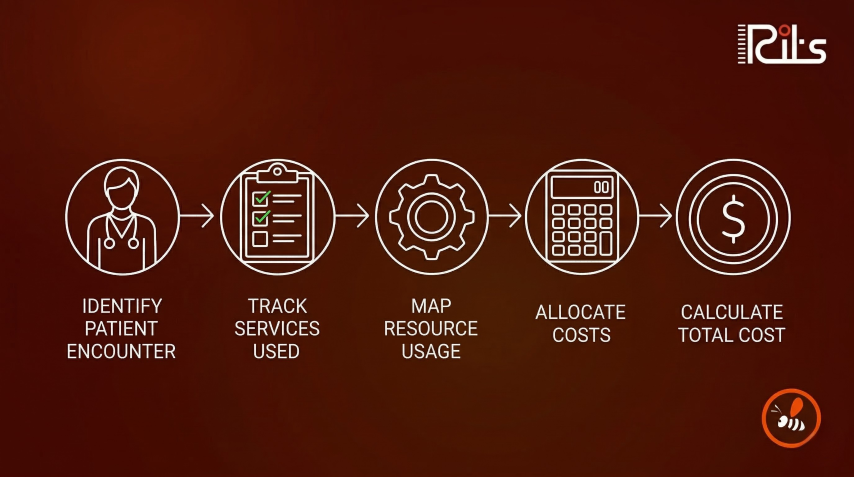
To understand patient-level costing, it helps to break it down into a simple process.
Step 1: Identify the Patient Encounter
Every costing process starts with a patient — whether it’s an outpatient visit, inpatient stay, or procedure.
Step 2: Track Services Used
This includes all services provided, such as:
-
Consultations
-
Lab tests
-
Imaging
-
Procedures
-
Medication
Step 3: Map Resource Usage
Each service consumes resources — staff time, equipment, consumables, and facilities.
Step 4: Allocate Costs
Costs are assigned to these resources using structured allocation methods.
Step 5: Calculate Total Cost per Patient
All allocated costs are combined to determine the final cost of care for that patient.
This structured approach ensures that costing is based on actual activity, not assumptions.
Methods Used in Patient-Level Costing
To achieve accurate patient-level costing, healthcare providers typically use structured costing methodologies.
Activity-Based Costing (ABC)
This method assigns costs based on activities involved in delivering care.
If you’re exploring this further, understanding activity-based costing in healthcare can help clarify how costs are linked to specific services.
Time-Driven Activity-Based Costing (TDABC)
This method goes a step further by calculating costs based on the time required for each activity.
It is especially useful in environments where time-based resource usage plays a significant role.
Patient-Level Costing in the UAE
In the UAE, patient-level costing is not just a best practice — it is becoming a regulatory expectation.
The Department of Health – Abu Dhabi, through the Abu Dhabi Clinical Costing Standards, requires healthcare providers to:
-
Link costs to patient encounters
-
Ensure accurate allocation of resources
-
Submit standardized cost data
This means healthcare providers must move away from generalized costing models and adopt systems that support detailed, patient-level data tracking.
If you haven’t already, it’s worth understanding how this fits into the broader framework of DOH clinical costing standards in Abu Dhabi, as patient-level costing is a core component of compliance.
Key Data Required for Patient-Level Costing
Accurate costing depends on accurate data.
Healthcare providers need to integrate multiple data sources, including:
-
Financial data (general ledger)
-
Clinical data (patient records, procedures)
-
HR and payroll data
-
Inventory and supply data
Without proper data integration, patient-level costing becomes unreliable and difficult to maintain.
Challenges in Patient-Level Costing
Despite its benefits, implementing patient-level costing comes with challenges.
Some of the most common include:
-
Disconnected systems and data silos
-
Inconsistent or incomplete data
-
Complex cost allocation methods
-
Lack of internal expertise
How to Implement Patient-Level Costing
Implementing patient-level costing requires a structured approach.
Healthcare providers should focus on:
-
Assessing current systems and data readiness
-
Aligning financial and clinical data
-
Defining cost centers and allocation logic
-
Building a reliable costing model
-
Validating and reconciling outputs
As the process becomes more complex, especially during allocation and data integration, many providers adopt a clinical costing software to streamline operations and improve accuracy.
This not only reduces manual effort but also ensures consistency and compliance with regulatory requirements.
Benefits for Healthcare Providers
When implemented correctly, patient-level costing offers long-term advantages.
It helps healthcare providers:
-
Gain full cost transparency
-
Improve operational efficiency
-
Optimize resource allocation
-
Support better financial planning
Over time, it becomes a strategic tool rather than just a reporting requirement.
Final Thoughts
Patient-level costing is changing how healthcare providers understand and manage costs.
It moves organizations away from assumptions and averages, toward precise, data-driven insights that reflect the true cost of care.
And in environments like Abu Dhabi, where structured costing frameworks are being implemented, it plays a critical role in both compliance and performance.
The key is simple:
Start early, build the right foundation, and ensure your costing model is accurate, scalable, and aligned with regulatory expectations.
Want more guidance on clinical costing or compliance in Abu Dhabi?
At RITS, we specialize in healthcare financial transformation. Our advanced software solution, QC Centra, is designed to simplify and automate clinical costing, ensuring accuracy, compliance, and efficiency for healthcare providers across the UAE.
If you’d like expert support or a personalized demonstration of QC Centra, feel free to reach out to our specialists.
Contact Us
📱 WhatsApp: +971 50 513 4009
Contact us
Let our team at RITS help you build a robust foundation for patient-level costing and regulatory compliance.