




Compliance Pressure, Data Gaps & Real Risks
1 .DOH Audit Pressure Is Increasing
The Department of Health in Abu Dhabi regularly reviews healthcare facilities in Abu Dhabi. These audits are becoming more frequent and more detailed as the emirate strengthens its digital health ecosystem. Authorities closely examine whether your systems are fully aligned with Malaffi requirements, including real-time data exchange and standardized reporting formats.
During audits, they typically check:
- Whether your system is actively connected to Malaffi
- Data accuracy, completeness, and reporting consistency
- Patient record accessibility across systems
❗ Clinics without proper integration risk:
- Warnings, fines, or compliance penalties
- Delays in licensing or service approvals
- Interruptions in daily operations and workflows
2. Fragmented Patient Data
Patients in Abu Dhabi often receive care from multiple providers, including:
- Clinics
- Diagnostic centers
- Hospitals
Without Malaffi EMR integration, patient information remains siloed across different systems. This fragmentation leads to serious challenges such as:
- Incomplete or delayed diagnoses due to missing history
- Repeated lab tests and imaging, increasing costs for both patients and providers
- Inconsistent treatment plans across healthcare facilities
- A poor and frustrating patient experience
Integrated systems, on the other hand, ensure a unified patient record—enabling continuity of care and better clinical decisions.
3 .Operational Inefficiencies
Many clinics still rely on partially manual or disconnected workflows, such as:
- Re-entering patient data into multiple systems
- Managing clinical and administrative data separately
- Handling insurance claims and approvals manually
These inefficiencies result in:
- Increased workload and burnout for staff
- Higher operational costs due to duplication of effort
- Slower patient processing and longer waiting times
- Greater risk of human errors in documentation and billing
With proper integration, these processes become automated and streamlined, freeing up staff to focus more on patient care.
4. Real-World Scenario
Imagine a patient visiting your clinic after receiving treatment at another hospital in Abu Dhabi.
Without Malaffi integration:
- No access to previous medical reports or prescriptions
- Delays in diagnosis and treatment decisions
- Higher risk of medical errors or unnecessary procedures
With proper integration:
- Complete patient history available within seconds
- Faster, more accurate diagnosis
- Reduced duplication of tests and procedures
- Improved patient safety and care outcomes
This shift from disconnected systems to a fully integrated digital ecosystem is no longer optional—it’s essential for compliance, efficiency, and delivering high-quality healthcare in Abu Dhabi.
What Is Malaffi EMR Integration?
Malaffi EMR integration connects your Electronic Medical Record (EMR) system directly to Malaffi, enabling seamless, secure, and real-time data exchange across Abu Dhabi. It allows healthcare providers to share and access unified patient records, ensuring continuity of care while meeting the requirements set by the Department of Health Abu Dhabi. Instead of operating in isolated systems, your clinic becomes part of a connected digital ecosystem that improves clinical decision-making and operational efficiency.
How It Works
- Patient data is captured and recorded in your EMR system during consultations, tests, and treatments
- The data is securely transmitted to Malaffi using approved standards and protocols
- Information is standardized, validated, and stored within the centralized health information exchange
- Authorized healthcare providers across the emirate can instantly access updated patient records when needed
This integration ensures your clinic is fully aligned with the UAE health data system, enabling real-time collaboration between providers, reducing duplication, and delivering faster, safer, and more informed patient care.
Key Features of Malaffi EMR Integration
1.Real-Time Data Access Across Abu Dhabi
Doctors can instantly access patient histories, lab results, prescriptions, and clinical notes from any facility connected to Malaffi. This immediate visibility supports faster decision-making, especially in emergencies, and ensures continuity of care across different providers. It also reduces dependency on patients to recall past treatments, minimizes delays caused by missing information, and improves coordination between specialists, general practitioners, and diagnostic centers. As a result, care becomes more proactive rather than reactive.
2. Unified Patient Records
All patient data is consolidated into a single, comprehensive profile, eliminating fragmented records. This unified view helps clinicians understand a patient’s full medical history, including allergies, chronic conditions, medications, and past procedures. It reduces duplication of records, avoids conflicting information, and ensures every provider is working with the same accurate dataset. Over time, this leads to better long-term care planning and improved patient trust in the healthcare system.
3.DOH-Compliant Data Exchange
Integration ensures your clinic meets all regulatory requirements set by the Department of Health, Abu Dhabi. It aligns your system with mandated standards for data sharing, reporting, and audit readiness—reducing compliance risks. Additionally, it simplifies the audit process by maintaining structured, traceable, and standardized records that can be easily reviewed by authorities. This proactive compliance approach helps clinics avoid last-minute corrections, penalties, or operational interruptions.
4. Secure & Encrypted Data Sharing
Patient data is protected through advanced encryption and strict security protocols in line with UAE healthcare data regulations. This ensures confidentiality, prevents unauthorized access, and safeguards sensitive medical information from breaches. Role-based access controls, secure authentication, and continuous monitoring further enhance data protection. These measures not only ensure compliance but also strengthen patient confidence in your clinic’s ability to handle their information responsibly.
5.Automated Reporting
Data is automatically shared with regulatory authorities, minimizing manual reporting tasks. This reduces administrative burden, improves accuracy, and ensures timely submission of required information. Automation also helps eliminate human errors in reporting, keeps your data consistently updated, and allows staff to focus more on patient care rather than paperwork. Over time, this leads to more efficient operations and better resource utilization within the clinic.
6. Interoperability
Malaffi integration is designed to work with multiple EMR systems without requiring a complete system overhaul. It enables smooth communication between different healthcare platforms, making it easier for clinics to upgrade without disrupting existing operations. This flexibility allows healthcare providers to scale their services, adopt new technologies, and integrate with future digital health initiatives. Ultimately, interoperability ensures your system remains adaptable, future-ready, and aligned with the evolving healthcare ecosystem in Abu Dhabi.
Choosing the Right EMR
While integration is mandatory, how smoothly you integrate depends heavily on your EMR system. Many clinics struggle not because of Malaffi itself, but due to legacy systems that are not built for modern interoperability. This is where advanced platforms like Shade EMR stand out for healthcare providers in the United Arab Emirates. Instead of treating integration as an afterthought, these systems are designed with compliance and connectivity at their core—ensuring seamless alignment with the Department of Health Abu Dhabi (DOH) requirements from day one.
Modern EMR solutions go beyond basic functionality. They are built to support structured clinical workflows, automated data validation, and real-time synchronization with external health systems. This means fewer data mismatches, reduced claim rejections, and smoother communication between clinics, hospitals, and insurance providers. Additionally, user-friendly dashboards, smart alerts, and integrated reporting tools help staff manage operations more efficiently without needing extensive technical expertise.
The advantage:
- Faster onboarding with guided implementation and minimal disruption
- Reduced dependency on IT teams due to built-in automation and support
- Fewer integration errors, ensuring consistent and reliable data exchange
- Better audit readiness with complete, traceable, and standardized records
- Improved insurance processing with accurate and timely data submission
In the long run, choosing the right EMR is not just a technical decision—it’s a strategic one. For clinic owners, it means smoother inspections, lower operational risks, improved staff productivity, and the ability to scale confidently within Abu Dhabi’s evolving digital healthcare ecosystem.
Best Practices for Successful Malaffi Integration
1. Choose a DOH-Compliant EMR System
Start with an EMR that is fully aligned with the standards of the Department of Health Abu Dhabi. Systems like Shade EMR are designed to meet compliance requirements from the ground up, reducing integration complexity. A compliant EMR ensures smoother connectivity with Malaffi and minimizes the risk of audit issues or technical delays.
2. Train Your Team Thoroughly
Even the best system will fail without proper user adoption. Train doctors, nurses, and administrative staff on how to use the EMR efficiently, including data entry standards, workflows, and reporting processes. Well-trained teams reduce errors, improve data quality, and ensure that the integration delivers its full value in day-to-day operations.
3. Maintain Accurate Patient Data
Data quality is critical for successful integration. Ensure that patient information is consistently entered, updated, and verified. Inaccurate or incomplete data can lead to compliance issues, claim rejections, and poor clinical decisions. Establish clear internal protocols for data entry to maintain reliability across all records shared through Malaffi.
4. Monitor Integration Performance Regularly
Integration is not a one-time setup—it requires continuous monitoring. Track system performance, data transmission success rates, and error logs to identify and resolve issues quickly. Regular audits and system checks help ensure that your clinic remains compliant and that data flows smoothly across connected healthcare providers in Abu Dhabi.
5. Work with Experienced Implementation Partners
Collaborate with experts who understand both the technical and regulatory aspects of Malaffi integration. Experienced partners can guide you through setup, testing, and compliance validation, helping you avoid costly mistakes. They also provide ongoing support, ensuring your system stays updated with evolving healthcare regulations and technology standards.
By following these best practices, clinics can achieve a smooth, reliable, and fully compliant integration—unlocking the full potential of connected healthcare in Abu Dhabi.
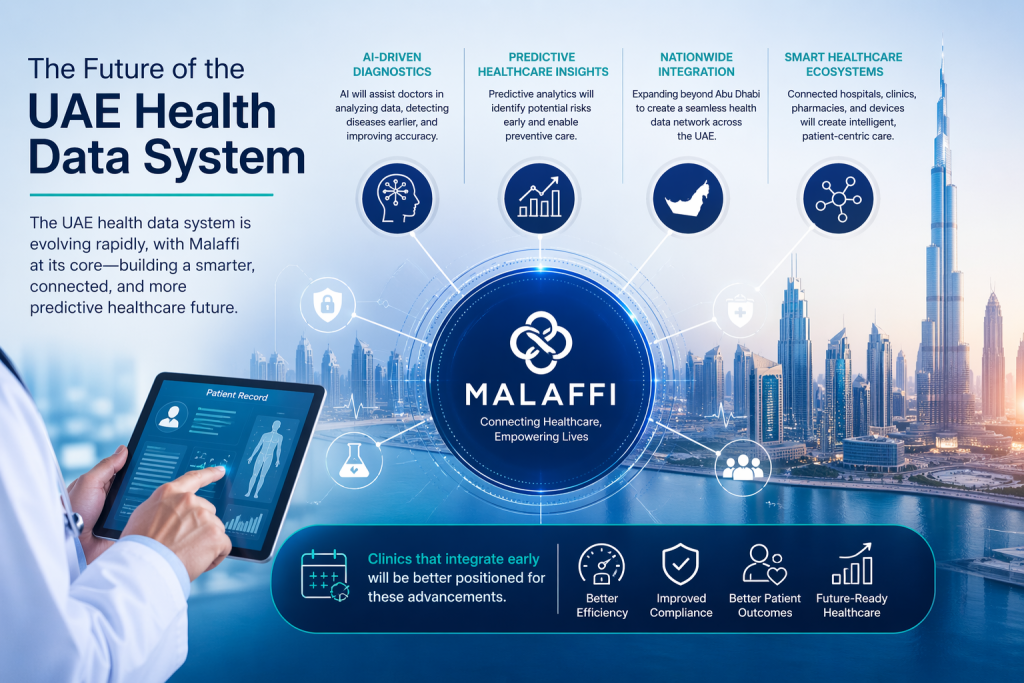
The Future of the UAE Health Data System
The United Arab Emirates health data system is evolving rapidly, with Malaffi at its core. What started as a health information exchange in Abu Dhabi is now shaping the foundation for a fully connected, data-driven healthcare ecosystem across the country. As digital transformation accelerates, healthcare providers are moving toward smarter, faster, and more predictive care models that rely heavily on real-time data integration and interoperability.
Future developments include:
- AI-Driven Diagnostics
Advanced technologies powered by Artificial Intelligence will assist doctors in diagnosing diseases earlier and more accurately. AI can analyze large volumes of patient data, detect patterns, and support clinical decisions—reducing human error and improving outcomes. - Predictive Healthcare Insights
With access to unified patient data, healthcare systems will shift from reactive treatment to preventive care. Predictive analytics can identify potential health risks before they become critical, enabling early intervention and personalized treatment plans. - Nationwide Integration Beyond Abu Dhabi
While Malaffi currently leads in Abu Dhabi, the vision is to expand integration across all emirates. This will create a seamless national health data network where patient records can be accessed securely anywhere in the UAE, improving continuity of care for residents and visitors alike. - Smart Healthcare Ecosystems
The future will include fully connected ecosystems where hospitals, clinics, pharmacies, insurance providers, and even wearable devices are integrated. This will enable real-time monitoring, automated alerts, and more efficient healthcare delivery at every level.
Clinics that adopt and integrate early will be better positioned to leverage these advancements. They will not only stay compliant but also gain a competitive edge through improved efficiency, better patient outcomes, and readiness for the next generation of digital healthcare in the UAE.
Conclusion
Compliance, Efficiency & Growth—All Depend on Integration.
For clinic owners and hospital administrators in Abu Dhabi, Malaffi EMR integration is not just a technical requirement—it’s a strategic necessity.
Failing to integrate properly can lead to:
- Compliance risks
- Financial penalties
- Operational inefficiencies
- Loss of patient trust
On the other hand, a well-integrated system allows you to:
- Pass DOH audits with confidence
- Deliver faster and safer patient care
- Reduce operational costs
- Strengthen your reputation in the UAE healthcare ecosystem
By choosing the right EMR system—one that is built for the UAE environment—you not only meet today’s requirements but also prepare your organization for the future of healthcare.