




The Digital Pulse of Healthcare: Why EMR Security Matters More Than Ever
The UAE’s vision for a smart and connected healthcare ecosystem is rapidly becoming a reality. Electronic Medical Records (EMR) systems are at the heart of this evolution, streamlining operations, enhancing diagnostic accuracy, and facilitating seamless information exchange. From appointment scheduling to complex treatment plans, EMRs hold a treasure trove of personal health information (PHI), including medical histories, diagnoses, lab results, and billing details. The sheer volume and sensitivity of this data make it an attractive target for cyber threats, ranging from ransomware attacks to data breaches. A compromise in EMR security can lead to severe consequences, including financial penalties, reputational damage, and, most importantly, a breach of patient trust. Therefore, for every healthcare provider in Abu Dhabi, prioritizing EMR security UAE is no longer an option but an absolute necessity to ensure the continuity of care and the integrity of patient information.
Navigating the Regulatory Compass: Malaffi and UAE Data Protection Laws
The UAE has established a comprehensive legal and regulatory framework to govern healthcare data, reflecting its commitment to patient privacy and data integrity. For healthcare providers in Abu Dhabi, understanding and adhering to these regulations is crucial. The primary standards include:
Abu Dhabi Healthcare Information and Cyber Security Standard (ADHICS)
ADHICS is the cornerstone of health information security in Abu Dhabi. It provides a detailed set of guidelines and requirements for protecting electronic health information, covering everything from risk management and incident response to access control and data encryption. Compliance with ADHICS is mandatory for all healthcare entities operating within the Emirate, ensuring a standardized and high level of healthcare data protection UAE.
Malaffi: The Centralized Health Information Exchange
Malaffi, Abu Dhabi’s centralized health information exchange platform, plays a pivotal role in connecting healthcare providers across the Emirate. While Malaffi facilitates the seamless sharing of patient data to improve care coordination, it also imposes stringent security requirements on all participating facilities. To connect to Malaffi, providers must undergo a rigorous security assessment, demonstrate robust data protection measures, and comply with specific protocols for data exchange and access. This ensures that even as data is shared, its security and privacy remain uncompromised. Malaffi’s emphasis on secure data exchange underscores the importance of an EMR system that is not only compliant but also inherently secure.
Federal Data Protection Laws
Beyond ADHICS and Malaffi, federal laws, such as the UAE Data Protection Law (Federal Decree-Law No. 45 of 2021), provide a broader framework for personal data protection across all sectors, including healthcare. These laws grant individuals rights over their data, including the right to access, rectify, and delete personal information, and impose strict obligations on data controllers and processors. A key aspect of these regulations is data residency, often requiring health data to be stored within the UAE’s legal jurisdiction, preventing its transfer outside the country without proper authorization. This mandates that EMR solutions must offer secure, in-country data storage capabilities.
The Unbreakable Shield: Key Pillars of Robust EMR Security
Achieving comprehensive EMR security UAE requires a multi-layered approach, integrating technological safeguards with stringent operational policies. Here are the fundamental pillars that every healthcare provider should look for in their EMR solution:
1. Advanced Encryption: Data at Rest and in Transit
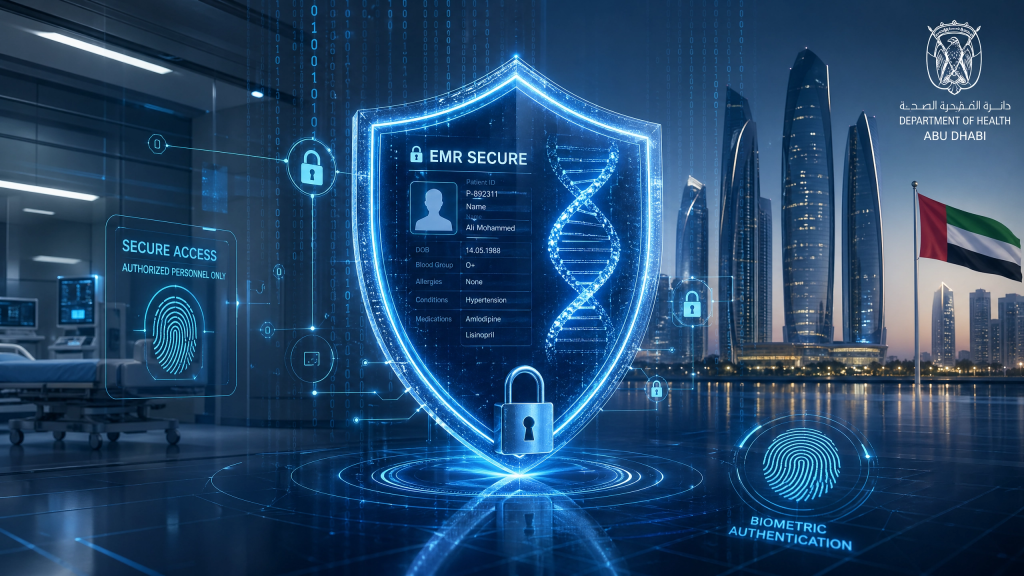
Encryption serves as the foundational layer of defense in any robust EMR security framework. It transforms sensitive patient data into an unreadable format, rendering it useless to unauthorized individuals even if they manage to gain access. A truly secure EMR system must implement strong, industry-standard encryption protocols for all Protected Health Information (PHI). This includes data at rest, meaning information stored on servers, databases, and backup systems, and data in transit, which refers to data being transmitted across networks, such as when a clinician accesses a patient record from a different location or when data is exchanged with other healthcare systems. Technologies like AES-256 for data at rest and TLS/SSL for data in transit are crucial. This comprehensive encryption strategy ensures that even in the event of a breach, the compromised data remains unintelligible, making advanced encryption standards an absolute non-negotiable for effective healthcare data protection UAE.
2. Granular Access Control and Multi-Factor Authentication (MFA)
Effective access control is paramount to preventing unauthorized individuals from viewing or manipulating sensitive patient information. Role-Based Access Control (RBAC) is a critical component, ensuring that healthcare professionals are granted access only to the data and functionalities strictly necessary for their specific roles and responsibilities. For instance, a receptionist might have access to scheduling and patient demographics, while a physician would have full access to medical histories and treatment plans. This granular approach minimizes the risk of internal data breaches and ensures adherence to the ‘least privilege’ principle.
Complementing RBAC, Multi-Factor Authentication (MFA) adds a crucial layer of security to user logins. Instead of relying solely on a password, MFA requires users to provide two or more verification factors from different categories – something they know (password), something they have (a token or smartphone), or something they are (biometrics like a fingerprint or facial scan). Implementing MFA significantly reduces the threat of unauthorized access, even if a password is compromised, making it an indispensable tool for robust EMR security UAE.
3. Comprehensive Audit Trails and Activity Logging
Transparency and accountability are non-negotiable in the realm of patient data. A secure EMR system must incorporate robust audit trails and activity logging capabilities. This means meticulously recording every single action performed within the system: who accessed what patient record, when they accessed it, what changes were made, and from which location or device. These logs serve multiple critical purposes. Firstly, they act as a powerful deterrent against misuse, as users are aware their actions are being monitored. Secondly, in the unfortunate event of a security incident or suspected breach, these detailed logs are invaluable for forensic investigations, allowing security teams to trace the origin and scope of the compromise. Finally, comprehensive audit trails are essential for demonstrating adherence to stringent healthcare data protection UAE regulations, providing verifiable evidence during compliance audits and legal proceedings. Without them, proving due diligence in data protection becomes significantly more challenging.
4. Data Residency and Secure Cloud Infrastructure
One of the most critical considerations for healthcare data protection UAE, particularly in Abu Dhabi, is data residency. UAE regulations often mandate that sensitive health data must be stored within the country’s legal jurisdiction. This means that EMR solutions, especially those leveraging cloud technology, must ensure their data centers are physically located within the UAE. This requirement is not merely geographical; it ensures that patient data is subject to UAE laws and oversight, providing an additional layer of legal protection.
For cloud-based EMRs, which offer unparalleled flexibility, scalability, and cost-efficiency, selecting a provider with a secure, in-country cloud infrastructure is paramount. A secure cloud infrastructure goes beyond mere location; it encompasses a suite of security measures, including:
- Physical Security: State-of-the-art data centers with restricted access, surveillance, and environmental controls.
- Network Security: Firewalls, intrusion detection/prevention systems, and DDoS protection to safeguard against external threats.
- Data Segregation: Ensuring that each client’s data is logically separated and protected from others within the shared cloud environment.
- Disaster Recovery and Business Continuity: Robust backup and recovery plans to ensure data availability and resilience against unforeseen events.
By adhering to these principles, EMR solutions can harness the power of the cloud while fully complying with UAE data residency laws and providing top-tier physical and cyber security for patient information.
5. Regular Security Assessments and Updates
The digital threat landscape is in a perpetual state of evolution, with new vulnerabilities and attack vectors constantly emerging. Therefore, EMR security UAE cannot be a static endeavor; it requires a dynamic and continuous commitment to vigilance and adaptation. A truly secure EMR solution is not merely implemented once but is maintained through an ongoing cycle of security assessments and updates.
This proactive approach includes:
- Vulnerability Assessments: Regular scans and analyses to identify potential weaknesses in the EMR system, its infrastructure, and associated applications.
- Penetration Testing: Ethical hacking simulations conducted by independent security experts to actively test the system’s defenses against real-world attack scenarios. This helps uncover exploitable vulnerabilities before malicious actors can.
- Timely Software Updates and Patch Management: Prompt application of security patches and software updates released by the EMR vendor and underlying operating system/database providers. These updates often address newly discovered vulnerabilities that could otherwise be exploited.
- Security Awareness Training: Continuous education for all EMR users on best practices for data security, phishing awareness, and incident reporting. Human error remains a significant factor in security breaches, making user training a vital component.
Healthcare providers must partner with EMR vendors who demonstrate a clear and proactive commitment to security maintenance and continuous improvement. This includes transparent communication about security practices, a robust incident response plan, and a track record of promptly addressing security concerns. This ongoing diligence is fundamental to maintaining an impenetrable defense against cyber threats and ensuring long-term healthcare data protection UAE
Shade EMR: Your Trusted Partner in Secure Healthcare Data Management
At RITS, we understand the unique challenges and stringent requirements faced by healthcare providers in Abu Dhabi. That’s why Shade EMR is meticulously designed to not only meet but exceed the highest standards of EMR security and healthcare data protection in UAE. As a leading healthcare software provider, we have engineered Shade EMR with a comprehensive suite of security features that align perfectly with ADHICS, Malaffi, and federal data protection laws.
Malaffi Compliance, Simplified
Shade EMR is built with Malaffi integration in mind, simplifying the complex process of connecting to Abu Dhabi’s health information exchange. Our system ensures that your facility meets all the necessary security assessments and protocols required by Malaffi, allowing for secure and compliant data exchange while maintaining the highest levels of patient privacy.
Uncompromising Data Protection
We employ state-of-the-art encryption for all data, both at rest and in transit, ensuring that patient information is always protected from unauthorized access. Our robust RBAC system guarantees that only authorized personnel can access specific data, while MFA adds an essential layer of user authentication. All data is securely hosted within UAE-based data centers, ensuring full compliance with data residency requirements.
Proactive Security and Continuous Innovation
Our commitment to security extends beyond initial implementation. Shade EMR undergoes continuous security monitoring, regular updates, and vulnerability assessments to stay ahead of emerging threats. We believe that proactive security is key to maintaining an impenetrable defense against cyberattacks, providing you with peace of mind.
Empowering Healthcare Providers
With Shade EMR, healthcare providers in Abu Dhabi can focus on what they do best: delivering exceptional patient care. Our intuitive interface, combined with powerful security features, allows your team to manage patient data efficiently and securely, without compromising on usability or performance. We empower you to navigate the digital healthcare landscape with confidence, knowing that your patient data is in safe hands.
Beyond Compliance: Building Trust and Ensuring Patient Safety
Ultimately, robust EMR security UAE is about more than just avoiding penalties or meeting regulatory checklists; it is about fostering a deep-seated culture of trust and ensuring the holistic safety and well-being of every patient. In an era where data is as vital as clinical expertise, the security of that data becomes a direct extension of the care provided. When patients know their sensitive health information is securely managed through advanced protocols, it builds a profound sense of confidence in the healthcare system as a whole. For healthcare providers, this commitment translates into an enhanced professional reputation, stronger and more transparent patient relationships, and a solid foundation for sustainable growth in a competitive market.
By investing in a secure EMR solution, you are not just protecting digital files; you are protecting lives, preserving privacy, and safeguarding the future of healthcare in Abu Dhabi. This investment goes beyond software—it is an investment in operational excellence, unwavering regulatory adherence, and, most importantly, in the invaluable trust placed in you by your patients. It ensures that as your practice grows and technology evolves, your commitment to patient confidentiality remains an unbreakable promise, positioning your facility as a leader in the digital health revolution.
Conclusion
The digital transformation of healthcare in Abu Dhabi presents immense opportunities for innovation, efficiency, and superior patient outcomes, but it also underscores the critical importance of EMR security UAE. As the industry moves toward a more interconnected future, the ability to safeguard sensitive information becomes a defining characteristic of a successful healthcare practice. For healthcare providers, navigating the complexities of regulations like ADHICS and Malaffi, while implementing advanced security measures, is no longer just a hurdle to overcome—it is a strategic advantage that builds lasting patient loyalty.
Choosing a partner like RITS, with a solution like Shade EMR, provides the assurance that your healthcare data protection in the UAE needs are not just met, but exceeded. Our commitment to security goes beyond compliance; we provide a scalable, future-ready platform that evolves alongside the shifting threat landscape and regulatory updates. By integrating Shade EMR into your practice, you are investing in a foundation of excellence that prioritizes safety, transparency, and operational resilience. Embrace the future of healthcare with confidence, knowing that your patient data is secure, compliant, and managed with the utmost integrity, allowing you to focus on what truly matters: the health and well-being of your community.