




If you run or manage an outpatient clinic in Abu Dhabi, you have probably heard the word ADOC a lot this year. It is changing how outpatient care is paid for, and the change is planned to take full effect on 1 January 2027.
This guide covers the basics: what ADOC is, why it is happening, the key dates, how shadow billing works, and what it all means for your clinic.
What is ADOC?
ADOC stands for Abu Dhabi Outpatient Classification. It is the Department of Health – Abu Dhabi’s new way of paying for outpatient care.
Today, most outpatient claims are paid on a fee-for-service basis: every item on a claim, such as a consultation, a test or a procedure, is priced and paid separately.
Under ADOC, each outpatient visit is given one class, and that class decides the payment. In short: one visit, one class, one payment.
Why is it changing?
DoH describes ADOC as part of its efforts to improve healthcare reimbursement and move towards value-based healthcare, where payment reflects the patient’s condition and the care delivered rather than the number of items billed. It also gives every outpatient provider in the emirate one standard way to classify and claim for visits.
In scope and out of scope
ADOC covers outpatient care, but not every facility, setting or service falls under it. Here is how the scope is currently set out.
In scope:
- Outpatient visits at DoH-licensed providers
- Telemedicine: online consultations that are equivalent to a face-to-face visit
- Specialist care: specialist consultations, procedures and allied-health services, plus the diagnostics linked to them
- GPs privileged into another specialty: they bill under that specialty’s class (DoH confirmation pending)
Out of scope*:
- Care settings: inpatient, emergency, daycase and home-based care
- Primary care: family medicine and GP clinics, unless the GP is privileged into a specialty
- Dental clinics and pharmacies
- Specific services: dialysis, IVF, premarital and IFHAS screening, well-child visits and IPC teleconsultations
- Drugs, devices and consumables
Anything out of scope is still billed, but separately under DoH’s existing Claims and Adjudication Rules. It never carries an ADOC class.
*Based on DoH’s current ADOC shadow billing guidance (version 1.4) and DoH Circular 76/2026. DoH may update the scope of ADOC, so check the latest DoH announcements.
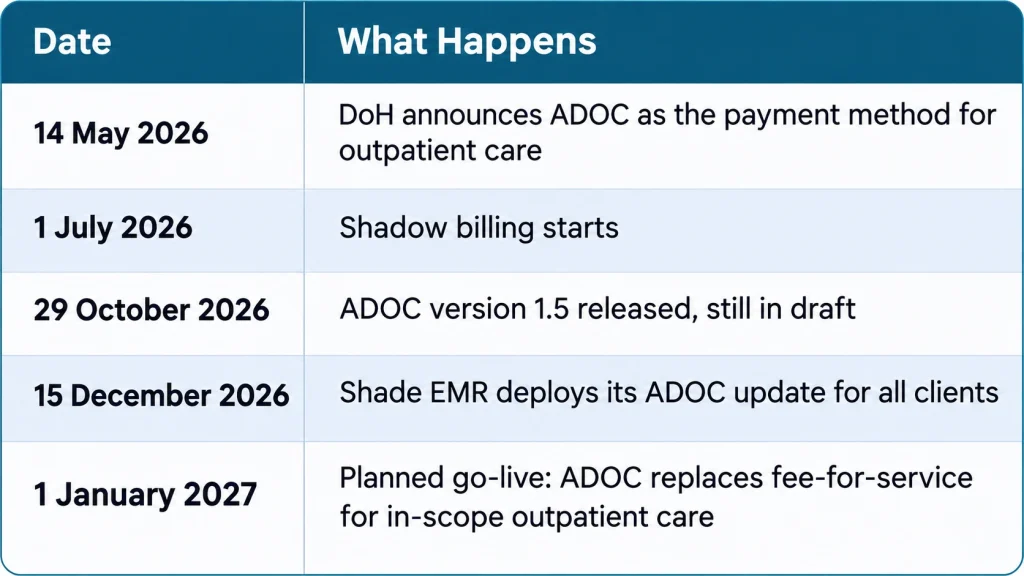
Key dates
What is shadow billing?
Shadow billing is a test run before go-live. Clinics keep billing exactly as they do today, and send ADOC data in parallel through Shafafiya, DoH’s platform for health insurance claims. Shadow billing has its own separate environment, so it never affects what clinics are paid.
Its purpose is measurement: DoH uses real outpatient activity, and feedback from providers, to check and fine-tune the classification before payment switches over. Shadow billing results are for preparing and testing, not final payment outcomes, and the rules used during this period are still drafts that DoH updates as it goes.
What changes for clinics?
The biggest change is how a visit turns into payment. Instead of adding up items, the visit is classified, and the class sets what the clinic is paid. For most clinics, this means moving from CPT-based billing to ADOC classes. CPT codes are still reported, but linked to the visit’s ADOC class, and separate E&M coding is planned to no longer be needed for in-scope outpatient services.
This makes clinical documentation more important than ever. The class depends on what is recorded about the visit, so clear, complete notes help each visit get the right class.
What should clinics do now?
- Use shadow billing to test ADOC claims before go-live
- Make sure your clinic system follows the latest ADOC rules from DoH
- Document every visit clearly
- Review shadow billing results and fix issues early
- Share coding questions and unusual cases with DoH, to help shape the final rules
- Keep an eye on DoH updates, including the ADOC Price List
ADOC in Shade EMR
ADOC rules change as DoH releases new versions, and your clinic system needs to keep up. Every ADOC update up to version 1.4 is now in Shade EMR, and the update will be deployed for all clients on 15 December 2026.
Shade EMR supports clinics across the ADOC workflow:
- A smooth move from CPT to ADOC: clinics keep their existing CPT billing while ADOC classes are added alongside, without disrupting daily work
- ADOC-structured XML: ADOC claims are generated in the structure DoH requires, with each line linked to the right visit
- Production and shadow billing: regular claims go to production and ADOC data goes to DoH’s separate shadow billing environment, linked through the same claim IDs
- Mapping review: clinics can review how CPT codes map to ADOC classes before claims go out
Have questions about ADOC and your clinic? Talk to our team. We’ll walk you through what ADOC means for your clinic and how Shade EMR supports it.
Sources
This article is for general information. Always check the latest ADOC rules with DoH.